

Special Correspondent, Kathmandu:
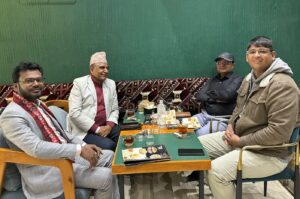
A significant and fruitful discussion meeting was held in the Nepalese capital, Kathmandu, on Saturday noon to elevate the economic relations between Bangladesh and Nepal to a new height. The meeting featured detailed exchanges on the development of the garment, education, healthcare, and tourism sectors of both countries, expansion of investment, and enhancement of bilateral cooperation.
The chief guest of the event was Mr. Anand Prasad Pokharel, former Minister of Culture, Tourism and Civil Aviation of Nepal. Special guests included prominent Nepali social worker Upendra Pudasaini, Managing Director of Digital Medical Tourism Anwaruzzaman Azad, and Executive Director of the Asian Business Partnership Summit, Md. Golam Faruk Majnu. Business leaders, entrepreneurs, and industry representatives from various sectors of both countries also attended the meeting.
Speakers at the discussion highlighted the immense potential for trade and investment cooperation between Bangladesh and Nepal, citing their geographical proximity, cultural similarities, and longstanding historical friendship. In particular, opportunities for joint investment in Bangladesh’s ready-made garment industry, pharmaceuticals and healthcare sector, and Nepal’s tourism and hydropower sectors were discussed.
Emphasizing the prospects of digital medical tourism in the healthcare sector, participants noted that coordinated efforts between Bangladeshi hospitals and specialist doctors could ensure advanced medical services for Nepali patients. In the education sector, importance was placed on expanding student exchange programs, joint research initiatives, and scholarship opportunities.
In his remarks, former Minister Anand Prasad Pokharel stated that the government and relevant authorities in Nepal would extend cooperation to ensure an investment-friendly environment for Bangladeshi entrepreneurs. He assured that necessary administrative support and policy incentives for establishing and expanding businesses in Nepal would be positively considered. He further added, “If Bangladesh and Nepal move forward based on mutual trust and cooperation, they can make a significant contribution to the regional economy of South Asia.”
Md. Golam Faruk Majnu, Executive Director of the Asian Business Partnership Summit, stressed the importance of establishing direct communication and business networks between the private sectors of the two countries. He proposed organizing regular business dialogues, trade fairs, and investment summits to strengthen bilateral engagement.
Participants also expressed the view that improving transport and logistics facilities, simplifying banking channels, and effectively implementing bilateral trade agreements would play a crucial role in expanding Bangladesh–Nepal trade relations.
The meeting concluded with optimism that such high-level discussions and coordinated initiatives would further strengthen and establish the economic relationship between the two countries on a sustainable foundation. The event is being considered a positive step toward opening a new horizon in the friendly relations between Bangladesh and Nepal.