

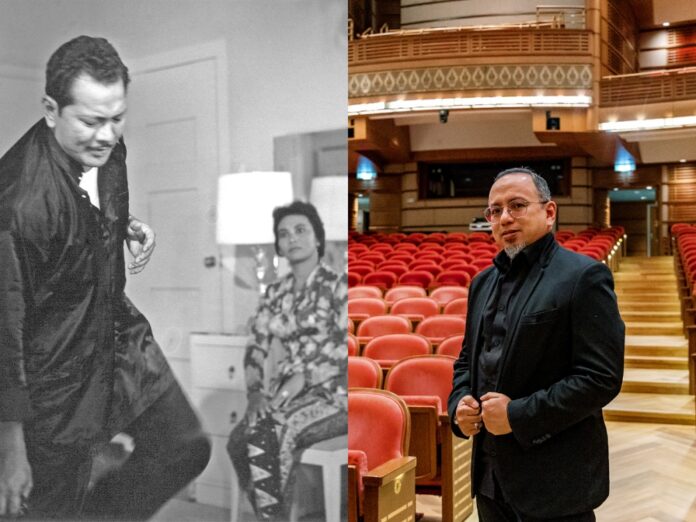
The Malaysian Philharmonic Orchestra (MPO) is set to stage a live film concert of the late Tan Sri P. Ramlee’s iconic, award-winning film Madu Tiga in a two-night showcase later this month.
Originally planned as a one-night event, high public demand prompted MPO to add another night, with P. Ramlee’s Madu Tiga: Live in Concert now scheduled for January 23 and 24 at Dewan Filharmonik Petronas (DFP).
The film concert marks MPO’s second time presenting a local film, following Ola Bola in 2016, as part of its efforts to diversify programming while paying tribute to the national icon.
Why ‘Madu Tiga’?
“We thought about what if we take a P. Ramlee movie that people least expected – because most would go with his more melancholy movies but we thought of going with P. Ramlee’s humorous approach,” said MPO conductor Ahmad Muriz Che Rose.
“After some time evaluating and re-evaluating, here we are, holding a tribute concert for P. Ramlee in a more refreshing way – or should I say as it is, because what is there to redo about P. Ramlee right?” he added.
“So we are actually revisiting this whole concept and giving it an even bigger pedestal deserving of a national icon,” Muriz said.
Produced in 1964 by Malay Film Productions under Shaw Brothers in Singapore, Madu Tiga is celebrated for its satirical humour and won Best Comedy Film at the Asian Film Festival in Taipei that same year.
The film, which explores local polygamic culture, features P. Ramlee alongside other legendary stars including Datuk Sarimah Ahmad, Zahara Agus, Jah Haji Mahadi and Ahmad Nisfu.
It also features several evergreen songs performed by P. Ramlee and Saloma, including Pukul Tiga Pagi, Selamat Pengantin Baru, Gambus Jodoh and Madu Tiga.
Muriz, leading the 65-member MPO, said preparations for the live film concert began last year and involved extensive technical work to isolate sounds from the 1960s film.
“For example the past concert films we’ve staged such as Harry Potter, La La Land, Star Wars – these Hollywood films in terms of its dialogues, visuals, music and the special effects, you’re just a button away from muting everything,” he said.
“But this is a 1964 film where they didn’t even have the technology at that time, so we have to actually do everything from scratch,” Muriz added.
He explained that local experts were enlisted to isolate the film’s audio, while MPO musicians had to rewrite all the notes from the film’s scores, as proper archives did not exist for films of that era.
Another challenge, and the reason Muriz was drawn to the project, is synchronising the film scores and sound effects in real time.
“So for me, what pulls me into the project is to synchronize the beautiful orchestral music in the background with every scene,” he said.
“Every nuance, every sound that you hear, even the eye wink by P. Ramlee in the film, is supplemented with music and everything needs to be written out too.”
“To make people not realise that the music that they hear during the screening is live, that is the real challenge that I’m looking forward to,” Muriz added.